 PE Collective
Best LLM Frameworks & Libraries 2026: Picks for RAG, Agents, and Chatbots
Seven frameworks, seven different bets on how LLM apps should be built. We tested them all. For a focused comparison of orchestration frameworks specifically (LangChain vs LlamaIndex vs CrewAI), see LLM Orchestration Frameworks.
Last updated: 2026-04-07
Building an LLM application from scratch is a terrible idea. You'll spend weeks writing boilerplate for prompt templates, chain orchestration, retrieval, and memory management before you get to the part that actually matters. That's where frameworks come in.
The problem is there are too many of them now. LangChain was basically the only option in 2023. By April 2026, you've got at least a dozen serious contenders, each with a different philosophy about how LLM apps should be structured. Some want to abstract everything away. Others give you building blocks and stay out of your way. The agent revolution has made the framework choice even more important, since agent orchestration is where frameworks save the most engineering time.
We built the same RAG application with all seven of these frameworks: a document Q&A system over 10K pages of technical docs with citations, filtering, and streaming. We also tested agent workflows where each framework had to coordinate tool calls, handle errors, and iterate autonomously. The differences in developer experience were massive.
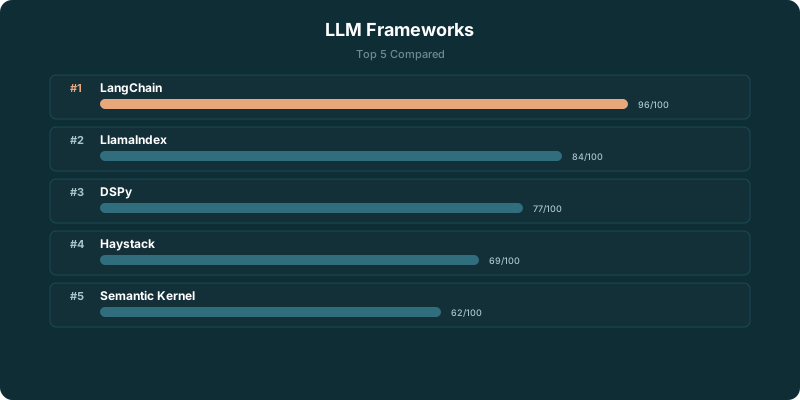
Our Top Picks
Detailed Reviews
LangChain
Best OverallLangChain has the largest ecosystem, the most integrations, and the biggest community of any LLM framework. Version 0.3+ cleaned up the messy abstractions that plagued earlier releases. LangChain Expression Language (LCEL) makes chain composition much more readable than the old sequential chain pattern. The integration list is staggering: 700+ components covering every vector store, LLM provider, and tool you can think of. LangGraph, the agent framework built on LangChain, is now the recommended way to build stateful multi-step agents with human-in-the-loop controls. LangGraph Cloud provides managed hosting for production agent deployments starting at $35/month.
LlamaIndex
Best for RAGLlamaIndex is purpose-built for retrieval-augmented generation and it does that one thing better than anything else. The data connectors handle 160+ file formats out of the box, from PDFs to Notion pages to Slack threads. The indexing strategies (vector, keyword, tree, knowledge graph) give you options that LangChain's retrieval module can't match. If you're building a system that answers questions over your organization's documents, start here.
Haystack
Best Open SourceHaystack takes the most principled approach to framework design. Everything is a component with typed inputs and outputs. Pipelines are directed graphs you can visualize, debug, and test node by node. There's no magic. When something breaks, you know exactly where and why. Haystack 2.x (the full rewrite) has matured significantly through early 2026 with better agent support, streaming pipelines, and an expanding integration ecosystem. The deepset team has added native support for tool calling, structured outputs, and pipeline-level error handling that makes production deployments more reliable.
Semantic Kernel
Best for .NETSemantic Kernel is Microsoft's answer to LangChain, and it's the only first-class option for .NET developers. It supports C#, Python, and Java, but the C# SDK is clearly the most polished. Azure OpenAI integration is native. The plugin architecture maps well to enterprise patterns that .NET developers already know. If your stack is Azure and C#, nothing else comes close to the developer experience here.
DSPy
Best for Prompt OptimizationDSPy takes a radically different approach. Instead of hand-writing prompts, you define what your pipeline should do and DSPy optimizes the prompts automatically. It treats prompt engineering as a machine learning problem: define your metric, provide examples, and let the optimizer find the best prompt configuration. DSPy 2.6 (released early 2026) added support for multi-model optimization, where the optimizer can select the best model for each module in your pipeline. This means DSPy can find that Module A works best with Claude Haiku and Module B needs GPT-4.1, optimizing both cost and quality simultaneously.
Vercel AI SDK
Best for TypeScriptThe Vercel AI SDK has become the default choice for TypeScript developers building AI features in Next.js, React, and Node.js applications. It provides streaming UI components, structured output parsing, tool calling, and multi-step agent workflows in a package that feels native to the JavaScript ecosystem. The SDK supports every major provider (OpenAI, Anthropic, Google, Mistral, and more) through a unified interface, so switching models is a one-line change. For full-stack TypeScript developers, this eliminates the need for Python-based frameworks entirely.
PydanticAI
Best for Type-Safe AgentsPydanticAI brings the type safety and validation that made Pydantic the standard Python data library to LLM application development. Built by the Pydantic team, it uses Python type hints to define agent behaviors, tool signatures, and structured outputs. The result is AI code that your IDE can autocomplete, type-check, and validate at runtime. It supports dependency injection for testing, streaming responses, and multi-model workflows. For Python developers who find LangChain's abstractions too heavy, PydanticAI offers a lighter alternative that stays close to standard Python patterns.
How We Tested
We implemented an identical RAG-based document Q&A application with each framework, measuring time-to-working-prototype, lines of code required, documentation quality, debugging experience, and production readiness. We also evaluated community activity (GitHub stars, npm/pip downloads, Discord/Slack responsiveness) and how well each framework handles model switching between OpenAI, Anthropic, and open-source models.
Frequently Asked Questions
Should I use LangChain or LlamaIndex for RAG?
LlamaIndex. It's purpose-built for retrieval and does it better. LangChain's retrieval module works fine for simple cases, but LlamaIndex's indexing strategies, data connectors, and query engine options are more sophisticated. Use LangChain when your application does RAG plus a lot of other things (agents, tool use, complex chains).
Can I switch frameworks later without rewriting everything?
Partially. Your LLM calls, vector store data, and embeddings are portable since they're just API calls and arrays. Your pipeline orchestration code is not portable. Moving from LangChain to Haystack means rewriting how your components connect, how data flows, and how you handle errors. Budget 2-4 weeks for a production migration. The earlier you choose, the less pain later.
Is DSPy ready for production use?
It depends on your team. DSPy is production-ready in the sense that it works and produces reliable outputs. But it requires ML engineering skills that most application developers don't have. If your team includes people comfortable with metrics, optimization, and evaluation datasets, DSPy can outperform hand-written prompts significantly. If you just want to ship features, stick with LangChain or LlamaIndex.
Do I even need a framework, or should I just call the API directly?
For simple applications (single LLM call, basic prompt template), call the API directly. Frameworks add overhead you don't need. Once you're doing retrieval, multi-step chains, tool use, or streaming with error handling, a framework saves you from writing thousands of lines of plumbing code. The breakpoint is usually around the second week of building, when you realize you're reimplementing LangChain badly.