 PE Collective
Best LangChain Alternatives in 2026
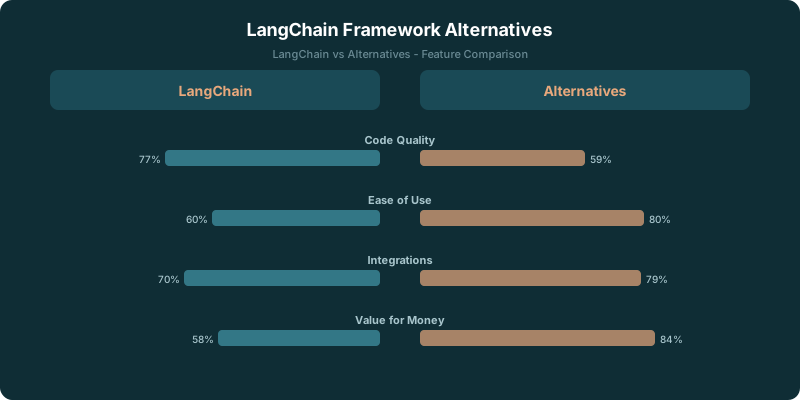
LangChain is the most popular framework for building LLM applications, but it's also the most criticized. The abstractions can be confusing. The API changes frequently. And for simple use cases, it adds complexity without proportional value. If you're looking for something different, these alternatives each take a distinct approach to the same problem.
The Alternatives
LlamaIndex
Free (open source) / LlamaCloud paid tiersRAG applications and data-heavy LLM projects
Purpose-built for RAG. Better data ingestion, indexing, and retrieval out of the box.
If your main use case is RAG (retrieval-augmented generation), LlamaIndex is a better fit than LangChain. It was designed from the ground up for connecting LLMs to data sources. The data connectors cover 160+ sources, and the indexing strategies are more sophisticated than what LangChain offers. The tradeoff: it's narrower in scope. For general-purpose LLM chains or agent workflows, LangChain is still more flexible.
Best LangChain alternative for RAG-focused applications.
DSPy
Free (open source)Teams who want to optimize prompts programmatically instead of manually
Replaces prompt templates with optimizable modules. The framework writes your prompts for you.
DSPy takes a radically different approach. Instead of writing prompts manually, you define input/output signatures and let DSPy's optimizers find the best prompts automatically. It's the most research-oriented framework on this list (created at Stanford). The learning curve is steep, but the results can be impressive: DSPy-optimized prompts often outperform hand-written ones on structured tasks. The DSPy 2.6 release in early 2026 added better support for multi-hop reasoning and simplified the optimizer API, making it more accessible to teams without deep ML backgrounds. If you're running prompt A/B tests manually, DSPy can automate that entire process.
Best alternative for teams ready to treat prompting as an optimization problem.
Semantic Kernel
Free (open source)Enterprise .NET and Java teams building LLM applications on Azure
Microsoft-backed, first-class C# and Java support. Deep Azure OpenAI integration. Enterprise patterns built in.
Semantic Kernel is Microsoft's LLM orchestration framework and the only first-class option for C# and Java developers. It supports plugins (reusable AI functions), planners (automatic task decomposition), and native Azure OpenAI integration. The plugin architecture maps cleanly to enterprise software patterns that .NET teams already know. For teams on Azure with existing C# or Java codebases, Semantic Kernel avoids the friction of adopting a Python-first framework like LangChain. The Python SDK exists but lags behind the C# version in features.
Best alternative for .NET and Java teams on Azure.
CrewAI
Free (open source) / Enterprise paidMulti-agent workflows where you need specialized AI roles working together
Role-based agent system. Define agents with specific expertise, assign tasks, let them collaborate.
CrewAI focuses on one thing LangChain does poorly: multi-agent orchestration. You define "crew members" with specific roles (researcher, writer, analyst), assign them tasks, and CrewAI handles the delegation and collaboration. The mental model is intuitive if you think in terms of team workflows. It's newer and less battle-tested than LangChain, but the developer experience is cleaner for agent-heavy applications.
Best alternative for multi-agent and crew-based workflows.
Haystack
Free (open source) / deepset Cloud paidProduction NLP pipelines with enterprise support needs
Pipeline-based architecture. More opinionated but easier to reason about in production.
Haystack predates LangChain and takes a more traditional software engineering approach. Its Haystack 2.0 rewrite introduced a clean pipeline architecture: you define components with typed inputs and outputs, connect them, and data flows through in a predictable way. No magic abstractions. The downside is less flexibility for experimental workflows, but the upside is code you can actually debug and maintain. deepset (the company behind Haystack) offers enterprise support through deepset Cloud, which matters for production deployments. The 2.0 release also added better model routing, improved document store integration, and a pipeline visualization tool for debugging complex flows.
Best alternative for production-grade, maintainable pipelines.
Simple applications or teams that want full control
No abstractions. Just API calls, your own code, and exactly the complexity you need.
For simple LLM applications, you don't need a framework at all. Call the OpenAI or Anthropic API directly. Use a vector database for RAG. Write your own prompt management. This approach gives you complete control and zero unnecessary abstraction. The downside is you'll rebuild utilities that frameworks provide for free: retry logic, streaming handlers, token counting, and output parsing.
Best alternative when frameworks add more complexity than they solve.
What Changed in the LLM Framework Landscape in 2026
The framework landscape looks different than it did a year ago. LangChain split into two projects: LangChain (the core library) and LangGraph (the agent orchestration layer). If you're building agents with LangChain today, you're probably writing LangGraph code whether you realize it or not. The split makes the core library simpler, but it also means learning two APIs instead of one.
LlamaIndex went through its own restructuring. The new architecture separates data ingestion, indexing, and querying into distinct packages. You can install just the parts you need instead of pulling in the entire framework. For teams doing RAG, this makes LlamaIndex lighter and easier to maintain in production.
DSPy gained serious traction in early 2026. What was a research project from Stanford is now showing up in production systems at companies that care about prompt quality. The 2.6 release simplified the optimizer API, which was the biggest barrier to adoption. It's still not for everyone, but it's no longer just for academics.
Haystack 2.x hit stable status. The pipeline architecture that felt experimental in 2025 is now battle-tested, and deepset's enterprise customers have put it through real production load. If you tried Haystack before the 2.0 rewrite and bounced off, it's worth a second look. The developer experience improved significantly.
The biggest shift isn't any single framework. It's that the "just use the raw SDK" crowd got louder, and they have a point. OpenAI's structured output support, Anthropic's tool use API, and Google's function calling all got better. The gap between what you need a framework for and what the native SDKs handle out of the box shrank.
When You Don't Need a Framework at All
Here's an opinion most framework docs won't give you: if you're making single API calls with structured output, skip the framework. Use the provider's SDK directly. OpenAI's response_format, Anthropic's tool use, or Google's function calling will handle structured responses without any abstraction layer.
Frameworks solve three problems that raw SDKs don't: multi-step chains where outputs feed into other calls, agent loops where the model decides what to do next, and RAG pipelines where you need retrieval and generation working together. If your application doesn't involve at least one of those patterns, a framework adds complexity without adding value.
The test is simple. Count the LLM calls in your workflow. If it's one call (even a complex one with tools), the SDK is enough. If it's two or more calls where the output of one determines the input of the next, that's where frameworks start paying for themselves with retry logic, state management, and error handling you'd otherwise write yourself.
Most people searching for LangChain alternatives don't need LangChain in the first place. They need a wrapper around an API call with some prompt management. A 50-line Python class does that. Save the framework for when your application grows into multi-step orchestration, and you'll avoid the abstraction tax on every simple call in between.
The Bottom Line
If you're doing RAG, try LlamaIndex first. If you want to optimize prompts automatically, DSPy is worth the learning curve. If you need multi-agent workflows, CrewAI has the cleanest API. If you need production support, Haystack is the safest bet. For .NET or Java teams on Azure, Semantic Kernel is the natural fit. And if your use case is simple enough, skip the framework entirely.
Related Resources
Beyond LangChain: Choosing the Right Framework for Your Project
LangChain became the default LLM framework because it shipped first and had the most tutorials. That doesn't mean it's the best choice for every project in 2026.
The core complaint with LangChain is abstraction bloat. Simple tasks require importing multiple classes and chaining objects together in ways that feel over-engineered. A basic RAG pipeline that takes 30 lines with LlamaIndex needs 80+ lines in LangChain. For teams that prioritize readability and onboarding speed, that matters.
LlamaIndex is the strongest alternative for retrieval-heavy applications. Its indexing and query pipeline is more intuitive, and it handles document chunking, embedding, and retrieval with fewer moving parts. If your application is primarily "chat with your data," LlamaIndex is the better starting point. We compared these two frameworks in detail in our LLM frameworks ranking.
For agent-heavy workloads, look at CrewAI or the OpenAI Agents SDK. CrewAI handles multi-agent orchestration with role-based delegation that LangGraph (LangChain's agent layer) can replicate but requires more boilerplate. We tested these in our agent framework comparison.
Semantic Kernel (Microsoft) is worth considering if your team is already in the Azure ecosystem. It integrates natively with Azure OpenAI Service and handles function calling cleanly. The Python SDK matured significantly in late 2025.
The simplest option: skip frameworks entirely. For straightforward API calls with structured output, the OpenAI and Anthropic SDKs are all you need. Adding a framework only makes sense when you need retrieval, agents, or complex chains that would be painful to build from raw API calls.
Frequently Asked Questions
Is LangChain still worth learning in 2026?
Yes, because it's the most widely used framework and appears in the most job postings. But you should also learn at least one alternative (LlamaIndex for RAG, DSPy for optimization) to understand the tradeoffs and have options.
What's the easiest LangChain alternative to learn?
CrewAI has the gentlest learning curve because its mental model (roles, tasks, crews) is intuitive. LlamaIndex is also approachable if you focus on its RAG capabilities. DSPy has the steepest learning curve.
Can I use multiple frameworks together?
Yes. A common pattern is using LlamaIndex for data ingestion and retrieval combined with LangChain or custom code for the application logic. DSPy can optimize prompts that are then used in any framework.
Which LangChain alternative is best for production?
Haystack is the most production-focused with its pipeline architecture and enterprise support from deepset. LlamaIndex with LlamaCloud is also production-ready. Semantic Kernel is the go-to for .NET enterprise teams. CrewAI and DSPy are newer and may require more custom infrastructure for production deployments.
What happened with Haystack 2.0?
Haystack 2.0 was a complete rewrite that replaced the old pipeline API with typed components and explicit data flow. The result is much cleaner code that's easier to debug and test. If you tried Haystack before 2.0 and found it confusing, give it another look. The new API is a significant improvement.