What is Hugging Face?
Hugging Face is an AI platform built around open-source models and tools. Think of it as the GitHub of machine learning: a place where researchers and developers publish, share, and collaborate on AI models, datasets, and applications. It started with the Transformers library for NLP and has grown into the central hub for the open-source AI community.
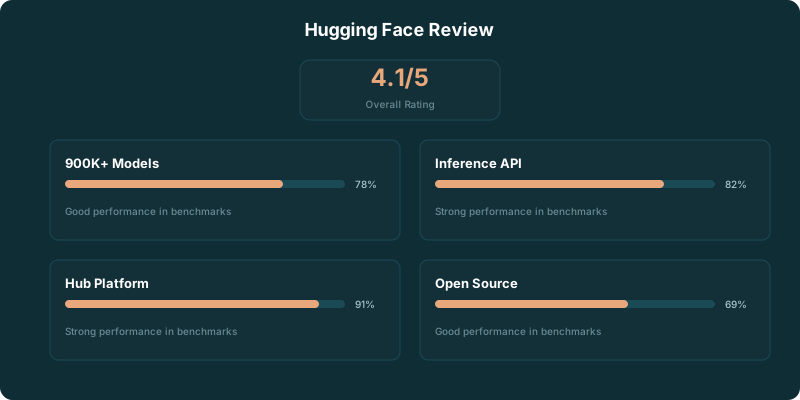
The platform has several parts: the Model Hub (900K+ models as of April 2026), Datasets (200K+ datasets), Spaces (hosted ML demos), the Inference API (use models via API), and the Transformers library (the Python framework that ties it all together).
Key Features
Model Hub
The Model Hub hosts over 900,000 models, from massive language models like Llama 4, Mistral Large, and Qwen 2.5 to specialized models for text classification, translation, image generation, and audio processing. Each model has a model card with documentation, usage examples, and performance metrics. You can filter by task, framework, language, and license.
For prompt engineers exploring alternatives to proprietary APIs, the Model Hub is where you compare open-source options. Llama 4 Scout and Maverick, Mistral Large, and Gemma 3 are competitive with GPT-4.1 for many production tasks at a fraction of the cost when self-hosted.
Transformers Library
The Transformers library is Hugging Face's open-source Python framework for loading and using ML models. It supports PyTorch, TensorFlow, and JAX. You can load a model in three lines of code, run inference, fine-tune on your data, and export for deployment. It's the de facto standard for working with transformer-based models.
Inference Endpoints
Inference Endpoints give you dedicated compute for deploying models in production. You choose the GPU (from T4 at $0.60/hour to A100 at $4.50/hour), Hugging Face handles the container, autoscaling, and load balancing. The platform now supports custom Docker images and private model deployment, making it viable for enterprise workloads that need data isolation. For developers who do not want to manage Kubernetes or cloud GPU instances directly, Inference Endpoints are the simplest path from a Hub model to a production API.
Spaces
Spaces are hosted web apps where you can build and share ML demos using Gradio or Streamlit. They're free to create and run on CPU, with paid GPU options for heavier models. It's a great way to showcase a model or let non-technical stakeholders interact with your work.
What Changed in 2026
The Open Model Boom
The Hub crossed 900,000 models in early 2026, up from roughly 500,000 a year ago. The growth is driven by the open-weight model releases from Meta (Llama 4 family), Mistral, Google (Gemma 3), Alibaba (Qwen 2.5), and dozens of smaller labs. Hugging Face is where these models land first, often hours after announcement. The Hub has become the de facto distribution channel for open AI models the way npm is for JavaScript packages.
Llama 4 and the New Open-Source Tier
Meta's Llama 4 release in April 2026 brought two models to the Hub: Scout (a 109B-parameter mixture-of-experts model with a 10 million token context window) and Maverick (a larger MoE model optimized for conversational and coding tasks). Both are available for immediate download and deployment through Inference Endpoints. For teams building RAG applications, Scout's 10M token context window is a transformative capability that was previously only available through proprietary APIs like Google's Gemini.
Inference API and Serverless Endpoints
Hugging Face launched serverless Inference API endpoints for popular models in 2026, allowing pay-per-token pricing without provisioning dedicated hardware. You can call Llama 4, Mistral, and Qwen models through a simple API at rates competitive with cloud providers. This positions Hugging Face as a direct alternative to AWS Bedrock and Google Vertex AI for teams that prefer open models without the infrastructure overhead.
Enterprise Hub Growth
The Enterprise Hub at $20/user/month now includes resource groups for isolating model access by team, audit logging for compliance, and fine-grained access controls that map to enterprise RBAC patterns. Organizations that previously self-hosted all model infrastructure are adopting Enterprise Hub as a managed model registry, even when they deploy to their own compute. The separation of model management (Hub) from model serving (Inference Endpoints or self-hosted) gives teams flexibility without vendor lock-in.
Pricing Breakdown
The free tier includes model downloads, dataset access, Spaces hosting (CPU), and rate-limited Inference API access. The Pro plan at $9/month gets you faster inference, private models, and early access to new features. Enterprise Hub at $20/user/month adds SSO, audit logs, and resource groups. Inference Endpoints are pay-as-you-go starting at $0.60/hour for GPU instances (T4) and scaling to $4.50/hour for A100 GPUs. Serverless API endpoints charge per token, similar to proprietary model providers.
✓ Pros
- Largest collection of open-source models, datasets, and spaces in one place
- Transformers library is the industry standard for working with ML models
- Inference API lets you use models without managing infrastructure
- Strong community with model cards, discussions, and leaderboards
✗ Cons
- Inference API free tier is rate-limited and not suitable for production traffic
- Finding the right model among 500K+ options can be overwhelming for beginners
- Dedicated endpoints get expensive for GPU-heavy models
- Documentation quality varies wildly between community-contributed models
Who Should Use Hugging Face?
Ideal For:
- ML engineers and researchers who need access to open-source models for fine-tuning, evaluation, or deployment
- Teams evaluating open-source vs. proprietary models who want to test Llama, Mistral, or Gemma before committing
- Developers building with the Transformers library since Hugging Face is the official home and best-documented path
- Anyone who needs quick model prototyping with Spaces and the free Inference API
Maybe Not For:
- Non-technical users who just want a chat interface (use ChatGPT or Claude instead)
- Teams that only need API access to frontier models like GPT-4.1 or Claude (use OpenAI or Anthropic directly)
- Production applications needing guaranteed uptime unless you're on paid Inference Endpoints
Our Verdict
Hugging Face is indispensable for anyone working with open-source AI models. The model hub is where Llama, Mistral, Gemma, and thousands of other models live. The Transformers library is the standard way to load, fine-tune, and deploy them. And the Inference API lets you test models without setting up infrastructure.
It's not a direct competitor to the Anthropic or OpenAI APIs. Those give you access to frontier models behind a simple API call. Hugging Face gives you access to the open-source ecosystem, which means more flexibility but also more responsibility for model selection, deployment, and optimization. If you're building with open-source models, Hugging Face is essential. If you just want the best model via an API, you don't need it.