What is the OpenAI API?
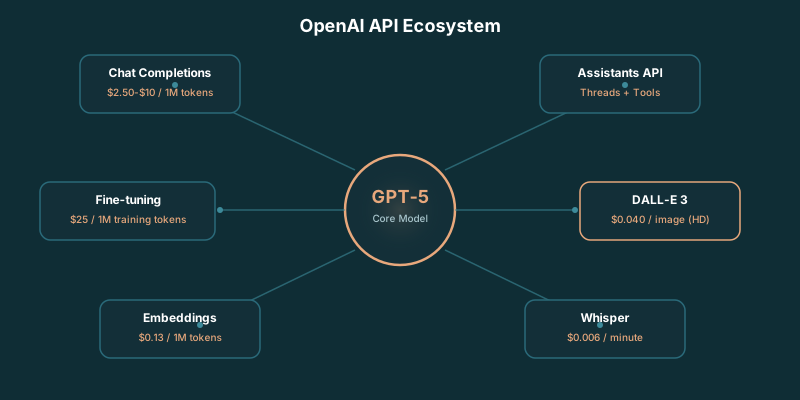
The OpenAI API is the developer platform for accessing GPT-5, GPT-4.1, DALL-E, Whisper, and OpenAI's other models. It's the most widely used AI API in the world, powering everything from ChatGPT-style chatbots to image generators, code assistants, and voice applications.
What sets OpenAI apart from competitors like Anthropic is breadth. While Anthropic focuses on text (and vision), OpenAI covers text, images, audio, embeddings, fine-tuning, and real-time voice. If you need multiple AI capabilities in one place, OpenAI is the most complete platform.
Key Features
GPT-4.1 Family and GPT-5
GPT-4.1 is OpenAI's recommended production model, replacing GPT-4.1. It has a 1M token context window and costs $2/$8 per million tokens. GPT-4.1 Nano ($0.10/$0.40) is the budget option for high-volume classification and extraction. GPT-5 ($1.25/$10) is the most capable model for agentic workflows and complex reasoning.
o3 and o4-mini (Reasoning Models)
The o3 ($2/$8) and o4-mini ($1.10/$4.40) models use chain-of-thought reasoning, spending internal tokens on complex problems before responding. o4-mini is the best-value reasoning model; o3 is for the hardest problems. Both outperform the deprecated o1 model at lower cost.
DALL-E 3 (Image Generation)
DALL-E 3 generates images from text descriptions. It's tightly integrated into the API, so you can build applications that combine text analysis with image generation. Pricing ranges from $0.04 to $0.12 per image depending on resolution and quality settings.
Whisper (Speech-to-Text)
Whisper transcribes audio to text with high accuracy across multiple languages. At $0.006 per minute of audio, it's cheap enough for production transcription workloads. It handles accents, background noise, and technical vocabulary well.
Fine-Tuning
OpenAI lets you fine-tune GPT-4.1 Mini and GPT-4.1 on your own data. This creates a custom model that performs better on your specific use case. It's useful for tasks where prompt engineering alone doesn't get the consistency you need. Anthropic doesn't offer fine-tuning as a self-service feature.
Pricing Details
OpenAI uses per-token pricing for text models and per-unit pricing for other capabilities. GPT-4.1 Nano: $0.10/$0.40. GPT-4.1: $2/$8. GPT-5: $1.25/$10. o4-mini: $1.10/$4.40. o3: $2/$8. DALL-E 3: $0.04-$0.12 per image. Whisper: $0.006 per minute. Fine-tuning has training costs on top of inference costs.
OpenAI API vs Anthropic API
See our full OpenAI API vs Anthropic API comparison. In short: OpenAI wins on platform breadth (images, voice, fine-tuning). Anthropic wins on reasoning quality and developer experience. GPT-4.1 Nano and Haiku 4.5 compete at the budget tier. For complex reasoning, Claude Opus 4.6 and o3 trade blows depending on the task type.
✓ Pros
- Broadest capability set: text, images, voice, embeddings, and fine-tuning all in one platform
- Largest ecosystem of third-party tools, libraries, and tutorials
- GPT-4.1 Nano is one of the cheapest capable models available for high-volume tasks
- Fine-tuning support lets you customize models on your own data
✗ Cons
- Reasoning quality on complex tasks has fallen behind Claude's Opus and Sonnet
- API changes and deprecations happen frequently, requiring code updates
- Rate limits and usage tiers can be confusing for new developers
- Documentation is spread across multiple sites and can be hard to navigate
Who Should Use OpenAI API?
Ideal For:
- Teams building multimodal applications that need text, image generation, and voice in one API
- Developers who need fine-tuning to customize model behavior on proprietary data
- High-volume applications where GPT-4.1 Nano's low cost makes it viable at scale
- Projects with existing OpenAI integrations where the ecosystem and tooling are already in place
Maybe Not For:
- Applications where reasoning quality is the top priority since Claude currently outperforms GPT-4.1 on complex analysis
- Teams that need long-context processing because Claude's 200K window is larger than GPT-4.1's 128K
- Developers frustrated by frequent API changes where Anthropic's API has been more stable
Our Verdict
OpenAI's API is the Swiss Army knife of AI platforms. No other single API gives you text generation, image creation, speech-to-text, text-to-speech, embeddings, fine-tuning, and real-time voice all under one roof. The ecosystem is the largest in the industry, with more tutorials, libraries, and third-party integrations than any competitor.
The catch is that being broad doesn't mean being best. For pure text reasoning, Claude's models have pulled ahead on benchmarks and in real-world developer experience. Anthropic's API docs are cleaner, and the developer experience feels more polished. But if you need a single API that covers text, images, and voice, OpenAI is still the only option that does it all. Choose based on what you're building.