 PE Collective
Pinecone Pricing 2026: Serverless Tiers, Read Units, and Monthly Cost Estimates
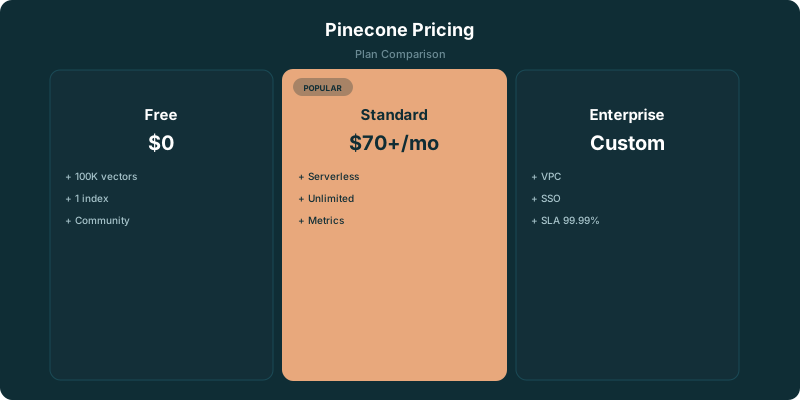
Pinecone's serverless pricing: Starter free, Standard at $50/month minimum, Enterprise from $500. You pay per read unit, write unit, and storage GB. This page covers the cost math. For a full review of Pinecone's features, performance, and how it compares to alternatives, see our Pinecone Review.
Starter (Free)
- ✓ 2GB index storage included
- ✓ 2 million write units included
- ✓ 1 million read units included
- ✓ 1 serverless index
- ✓ Community support only
Standard
- ✓ $50/month minimum commitment
- ✓ Storage: $0.33/GB/month
- ✓ Write units: $4 per million
- ✓ Read units: $16 per million
- ✓ SAML SSO, backup/restore, RBAC
Enterprise
- ✓ $500/month minimum commitment
- ✓ Write units: $6 per million
- ✓ Read units: $24 per million
- ✓ Private networking and CMK encryption
- ✓ HIPAA compliance available ($190/mo add-on)
Serverless vs Pods: Which Architecture Costs Less in April 2026
Pinecone now defaults every new index to serverless. Pod-based indexes still exist for legacy workloads, but new sign-ups land on serverless unless they explicitly request pods through Enterprise. This is the biggest pricing shift in Pinecone's history, and it changes how you think about costs.
Serverless pricing is pure usage: you pay for read units, write units, and storage. There is no idle compute charge. If nobody queries your index overnight, your bill is just storage. Pod-based pricing charged per pod-hour regardless of usage. An s1.x1 pod cost roughly $0.096/hour ($70/month) even if it sat idle. For bursty workloads with quiet periods, serverless saves 40-60% over equivalent pod configurations.
Where pods can still win: steady high-throughput workloads. If you are serving 50,000+ queries per minute around the clock, pod-based pricing with provisioned capacity is more predictable and can be cheaper per query than serverless at sustained volume. Pinecone's Enterprise tier offers pod access with committed use discounts for exactly this scenario.
For most RAG applications doing fewer than 10,000 queries per day, serverless on the Standard tier is the clear winner. You stay on the $50/month minimum for months before actual usage charges exceed it. The key metric to watch is read units: at $16 per million on Standard, a chatbot handling 50,000 queries/day generates roughly 1.5 million read units/month, costing about $24 in reads alone, well under the $50 minimum.
One operational difference: serverless indexes cold-start after periods of inactivity. The first query after a quiet period may take 2-5 seconds instead of the usual sub-100ms. Pod-based indexes maintain warm capacity and respond consistently. If your application needs guaranteed sub-100ms latency at all times, factor cold starts into the serverless vs pods decision.
Understanding Pinecone's Unit-Based Pricing
Pinecone charges for three things: storage ($/GB/month), write units (indexing vectors), and read units (querying vectors). Your monthly bill is the greater of your minimum commitment or your actual usage.
A write unit represents writing one vector to an index. Writing 1 million vectors costs $4 on Standard. A read unit represents one vector read during a query. A single query that scans and returns 10 nearest neighbors might consume 10+ read units depending on your index configuration.
Storage is straightforward: $0.33 per GB per month on Standard. The size of your index depends on vector dimensions and metadata. OpenAI's text-embedding-3-small (1536 dimensions) produces ~6KB per vector. One million vectors takes roughly 6GB, costing $2/month in storage.
The key insight: most RAG applications are read-heavy. You index once (or incrementally), but every user query triggers a read. A chatbot handling 10,000 queries per day generates ~300,000 read units per month, costing about $5 on Standard. Storage and write costs are usually smaller than read costs for production apps.
Real-World Cost Examples
Small RAG chatbot (100K vectors, 1K queries/day): Storage: 0.6GB × $0.33 = $0.20/month. Read units: ~30K/month × $16/1M = $0.48/month. Total usage: under $1/month. You still pay the $50 minimum. The free Starter tier would cover this easily.
Production SaaS with search (5M vectors, 50K queries/day): Storage: 30GB × $0.33 = $9.90/month. Read units: ~1.5M/month × $16/1M = $24/month. Write units (daily updates): ~100K/month × $4/1M = $0.40/month. Total: ~$35/month in usage, so you pay the $50 minimum.
Large-scale recommendation engine (50M vectors, 500K queries/day): Storage: 300GB × $0.33 = $99/month. Read units: ~15M/month × $16/1M = $240/month. Write units: ~1M/month × $4/1M = $4/month. Total: ~$343/month on Standard.
Enterprise healthcare app (10M vectors, HIPAA required): Standard usage might be $80/month, but you need Enterprise ($500 min) plus HIPAA ($190/month add-on). Total: $690/month minimum regardless of actual usage.
Pinecone vs Self-Hosted Alternatives
Pinecone's managed service competes with self-hosted vector databases like pgvector, Weaviate, Chroma, and Qdrant. The tradeoff is operational simplicity vs cost control.
pgvector (PostgreSQL extension) is free and runs on your existing database server. No minimum commitments. But you manage scaling, backups, and performance tuning yourself. For teams already running PostgreSQL, pgvector at zero marginal cost beats Pinecone's $50/month minimum for small workloads.
Weaviate Cloud starts at $45/month (Flex plan) with a similar usage-based model. Chroma Cloud has a free tier and pay-as-you-go pricing. Both are worth evaluating alongside Pinecone.
Pinecone's advantage is zero operational overhead and strong query performance at scale. If your team doesn't want to manage vector database infrastructure, Pinecone's $50-200/month Standard tier is reasonable for the convenience. If you have a DevOps team, self-hosted options save money on larger deployments.
Hidden Costs & Gotchas
- ⚠ The $50/month minimum on Standard means you pay $50 even if you use $5 worth of resources. Your usage only matters once it exceeds $50. This catches hobbyists and small projects off guard.
- ⚠ Read units cost 4x more than write units ($16/M vs $4/M on Standard). Read-heavy workloads like RAG applications pay more than write-heavy indexing pipelines.
- ⚠ Storage costs ($0.33/GB/month) add up with high-dimensional embeddings. A million 1536-dimension vectors (OpenAI embeddings) uses roughly 6GB, costing $2/month in storage alone.
- ⚠ Enterprise's $500/month minimum is non-negotiable. Even light usage costs $500. The premium buys private networking, CMK encryption, and HIPAA eligibility.
- ⚠ HIPAA compliance is an additional $190/month add-on on Enterprise tier. Healthcare applications need to budget for the total: $500 minimum + $190 HIPAA = $690/month before usage.
- ⚠ Pinecone offers a $300 credit for a 3-week trial on Standard. Use this to benchmark your actual costs before committing.
Which Plan Do You Need?
Personal project or prototype
Starter (free). 2GB storage and 1 million read units is enough for prototyping RAG applications with up to ~300K vectors. Upgrade to Standard only when you outgrow the storage or need RBAC.
Production RAG application
Standard at $50/month minimum. Most production RAG apps with 1-10 million vectors cost $50-200/month on Standard. Use the $300 trial credit to benchmark before committing.
Enterprise with compliance needs
Enterprise at $500/month minimum. Required for private networking, CMK encryption, or HIPAA compliance. Budget $500-2,000/month depending on vector count and query volume.
The Bottom Line
Pinecone's free tier is generous for prototyping. The jump to Standard ($50/month minimum) is where it gets real, most production RAG applications land between $50-200/month on Standard. Enterprise at $500/month minimum is for teams that need compliance features. Read-heavy workloads (which most RAG apps are) should budget around the read unit cost ($16/million) as the primary expense driver.
Related Resources
Frequently Asked Questions
How much does Pinecone cost?
Pinecone has a free tier (2GB storage, 5 indexes) and a usage-based Standard plan. Standard costs $8.25 per 1M read units, $2 per 1M write units, and $0.33/GB/month for storage. A typical small app costs $50-200/month.
Is Pinecone free tier good enough for production?
For small apps with under 100K vectors, yes. The free tier gives you 2GB storage and 5 serverless indexes. The main limitation is community-only support and single-region deployment.
How does Pinecone pricing compare to Weaviate?
Pinecone is cheaper for small workloads (serverless pricing starts lower). Weaviate becomes cheaper at scale because you can self-host on your own infrastructure. For medium workloads, both cost roughly $100-300/month.
What are Pinecone read units?
Read units are Pinecone's billing measure for queries. A simple vector search costs 1 read unit per 1,000 vectors scanned. Metadata filtering, larger result sets, and complex queries use more read units per query.