What is Chroma?
Chroma is an open-source vector database designed around developer experience. It's Python-native, runs in-memory by default, and gets out of your way. Where Pinecone requires a cloud account and Weaviate requires Docker, Chroma requires a pip install. That's it.
The project positions itself as the "AI-native open-source embedding database." In practice, it's the vector database that shows up in every tutorial, quickstart guide, and proof-of-concept. That's not an accident. Chroma was designed to minimize the distance between "I want to try vector search" and "I have vector search working."
Key Features
In-Memory and Persistent Modes
Chroma runs in two modes. In-memory mode stores everything in RAM for maximum speed during development. Persistent mode writes to disk so your data survives restarts. Both modes use the same API. Start with in-memory for prototyping, switch to persistent when you need durability. No code changes required.
Python-Native API
Chroma's API is Python through and through. Create a collection, add documents with metadata, and query by similarity. The API uses Python data structures (lists, dicts) rather than requiring you to learn a custom query language. If you're building in Python, Chroma feels like a natural extension of your codebase rather than an external service.
import chromadb
client = chromadb.Client()
collection = client.create_collection("my_docs")
collection.add(documents=["doc1", "doc2"], ids=["1", "2"])
results = collection.query(query_texts=["search term"], n_results=2)
That's a working vector database in five lines. No configuration files, no connection strings, no schema definitions.
Automatic Embedding
By default, Chroma uses a local embedding model to vectorize your documents automatically. You add text, Chroma creates the vectors. You can also bring your own embeddings if you prefer a specific model, or configure Chroma to use OpenAI, Cohere, or other embedding providers.
Framework Integrations
Chroma is a first-class citizen in the LangChain and LlamaIndex ecosystems. It's the default vector store in many of their examples and tutorials. If you're following a LangChain RAG tutorial, there's a good chance it uses Chroma. The integrations are well-maintained and straightforward.
Metadata Filtering
Like other vector databases, Chroma supports attaching metadata to documents and filtering on it during queries. Combine vector similarity with where clauses to narrow results by category, date, source, or any other attribute. The filtering syntax uses Python dicts and supports comparison operators.
Chroma Cloud
Chroma Cloud is the managed hosting option. It provides a serverless, distributed architecture so you don't have to run Chroma on your own infrastructure. New accounts get $5 in free credits to start, with usage-based pricing after that. The cloud offering is still relatively new compared to Pinecone's mature managed service, but it's actively developing.
Limitations
Chroma's simplicity comes with tradeoffs. There's no built-in hybrid search (keyword + vector). There's no native multi-tenancy. Replication and high availability aren't part of the open-source offering. Performance at scale (millions of vectors, high query throughput) doesn't match dedicated solutions like Pinecone or Weaviate.
These aren't bugs. They're scope decisions. Chroma optimized for developer experience and getting started fast. Production features at massive scale aren't the primary goal, at least not yet.
What Changed in Chroma in 2026
Chroma Cloud launched. It's a managed hosting option that puts Chroma in the cloud without requiring you to run your own infrastructure. It's still in preview, but it signals where the project is headed: keeping the simple API while solving the deployment problem.
Performance for large collections improved. Collections with 500K+ vectors are noticeably faster on both inserts and queries compared to a year ago. Multi-tenancy support got better, though it's still not at the level of Pinecone or Weaviate for true SaaS isolation.
The JavaScript/TypeScript client caught up to the Python client in feature coverage. If you're building a Node.js backend, Chroma is now a first-class option rather than a Python-only tool. The core project remains Apache 2.0 licensed and fully open source. No license rug-pulls here.
When Chroma Makes Sense (and When It Doesn't)
Use Chroma when you're prototyping a RAG app and want a vector database running in five minutes. Use it when you're building demos, running in development, or shipping a small production app with under 100K vectors. Use it when you want an embedded database with zero external dependencies. If your app is a Python script or a small web service, Chroma fits like a glove.
Don't use Chroma when you need more than 1 million vectors. Don't use it when you need high availability, automatic replication, or guaranteed uptime SLAs. Don't use it when you're running a multi-tenant SaaS product where tenant data isolation is a hard requirement. And don't use it when your production system needs to handle thousands of concurrent queries per second.
The sweet spot is development through early production. Chroma gets you moving fast with zero friction. Once your dataset outgrows it or your reliability requirements tighten, migrate to Pinecone, Weaviate, or pgvector. The migration isn't painful because vector database APIs are similar enough across tools.
Chroma vs Pinecone vs pgvector: Quick Decision Guide
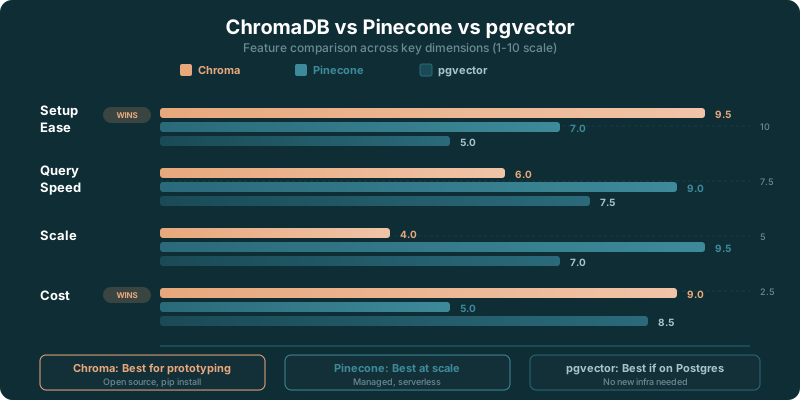
Picking a vector database comes down to what you value most. Here's the short version.
- Need zero ops? Go with Pinecone. You create an index and forget about infrastructure. It costs money, but it saves you from managing anything.
- Need open source and embedded? Go with Chroma. Pip install, import, done. No servers, no cloud accounts, no billing surprises.
- Already run Postgres? Go with pgvector. One extension, and your vectors live next to your application data. SQL joins between vector results and relational tables are the killer feature.
- Need hybrid search (keyword + vector)? Go with Weaviate. It's the only option here with built-in BM25 and vector search in the same query.
- Budget is $0/month? Chroma (self-hosted) or pgvector (if you already have Postgres). Both are free and open source.
Most teams prototype with Chroma, evaluate with pgvector if they run Postgres, and land on Pinecone when they need managed production infrastructure. That's not a failure of planning. It's a reasonable progression.
Chroma vs Pinecone
Pinecone is the managed production choice. Chroma is the lightweight development choice. Pinecone handles billions of vectors with managed infrastructure. Chroma handles development and small-to-medium workloads with minimal setup. Start with Chroma, move to Pinecone when scale demands it.
Chroma vs pgvector
pgvector makes sense if you already run PostgreSQL. Chroma makes sense if you want the fastest possible setup without existing infrastructure. Both are free. The choice usually depends on whether you have a Postgres database already.
✓ Pros
- Simplest setup of any vector database: pip install, import, done
- In-memory mode is perfect for development, testing, and prototyping
- Native integrations with LangChain and LlamaIndex work out of the box
- Python-native API feels natural, no new query language to learn
- Lightweight enough to embed directly in your application
✗ Cons
- Limited scalability for large production workloads with millions of vectors
- No built-in hybrid search or BM25 keyword matching
- Chroma Cloud is still relatively new and evolving
- Missing production features like multi-tenancy and replication that Weaviate offers
Who Should Use Chroma?
Ideal For:
- Developers prototyping RAG applications who want a vector database running in minutes, not hours
- Small to medium projects with under a million vectors where simplicity matters more than scale
- Tutorial and learning projects where Chroma's low setup cost lets you focus on the AI logic
- Applications using LangChain or LlamaIndex where Chroma is often the default vector store in examples and tutorials
Maybe Not For:
- Large-scale production systems with millions of vectors where Pinecone or Weaviate handle the load better
- Teams needing hybrid search since Chroma doesn't combine keyword and vector search like Weaviate does
- Multi-tenant SaaS products where native tenant isolation features aren't available in Chroma
Our Verdict
Chroma is the vector database you reach for when you want to start building instead of configuring. pip install chromadb, create a collection, add documents, query. You can go from zero to working RAG prototype in under ten minutes. No Docker, no cloud accounts, no API keys for the database itself. That developer experience is Chroma's defining feature.
The limitations show up at scale. Chroma works well for thousands to hundreds of thousands of vectors. Once you're pushing into the millions with high query throughput, you'll want Pinecone or Weaviate. Chroma Cloud is evolving to address the production gap, but it's still catching up to established managed offerings. The smart play is to prototype with Chroma and migrate to a production database when your scale demands it. The APIs are similar enough across vector databases that the migration isn't painful.